




Anyone looking for a pillow to counter neck pain quickly runs into big promises. We take a different approach and look at what the research actually gives us — including where the answer is surprising.
The starting point: surprisingly little firm evidence
Pillows accompany us for a third of our lives. You would think their effect on the neck had been thoroughly researched. It has not. There are a few good studies, they arrive at different results, and none of them allows the conclusion that one particular pillow model is the best.
That is not a disadvantage for you — quite the opposite. It helps to know what to watch out for in other people's promises.
What one controlled trial showed
The most meaningful investigation currently available comes from an Italian research group led by Carla Vanti, published in 2019 in the journal Physical Therapy. 64 people with chronic, non-specific neck pain completed the study. One group received an ergonomic spring pillow, the other received training on posture and sleep behaviour.
The result was clear: in the pillow group, 69.3 per cent of participants improved, in the training group 39.4 per cent. What was measured: less neck pain, less pain in the thoracic spine area, fewer headaches and better sleep quality.
So a suitable pillow can make a difference. That is the good news — and it is reasonably well documented.
What the same study qualifies
The authors name their own limits, and they do so very openly. Neither participants nor practitioners were blinded. Whether the pillows were really used every night could not be verified. Long-term data is missing.
The sentence that matters most to us comes at the end: whether a spring pillow works better than other ergonomic pillows has not been investigated so far.
That is why you will nowhere read from us that the SleepFit is scientifically proven to work. It is a different pillow with a different construction. Anyone who claims such a study for their own product stretches it beyond what it gives — and we will not go along with that.
And a study that calls for caution
Almost at the same time, Susan Gordon, Karen Grimmer and Petra Buttner examined people with documented degeneration of the cervical spine. Their pilot study appeared in 2019 in the European Journal of Physical and Rehabilitation Medicine.
Earlier investigations had shown that latex and polyester pillows noticeably improve morning neck complaints in the general population. In people with existing disc degeneration, this effect could not be reproduced.
The explanation is plausible: a pillow changes the position of the head and neck. Where the cause lies deeper, this change reaches its limits. A pillow is simply a pillow — and that is exactly how it should be judged.
What can be derived from this
The specialist literature agrees on one point: to measure the influence of pillows reliably, studies with more than 400 participants would be needed. So far, no such studies exist. That is why no best pillow model can be named — by anyone, for any product.
- A suitable pillow can help with non-specific neck complaints. One controlled trial supports that.
- Which construction works best is open.
- Comfort can be judged — and best of all by you yourself, in your own bed.
Why we are convinced all the same
We could also have left this article out. There is a reason we are writing it: we sell a comfort product, not a medical device — and you should know exactly what you are getting.
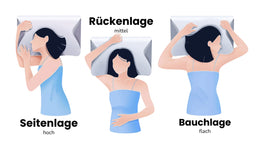
What convinces us about the SleepFit is something other than studies. We developed it over months, tested it ourselves and reworked it again and again until the shape worked for all three sleeping positions: the side recess with an arm rest, the stable middle section for the back, the flatter zone for front sleepers.
And we listen to what comes back. In our customer survey, 75 people reported after four weeks of use — 97 per cent of them reported less tension in the neck and shoulder area. These are self-reports and not a study. But it is what counts for us.
Sleep is individual — hence this promise
Precisely because no best pillow can be derived from the research, we do not believe in one solution for everyone. What sits perfectly for one person is too high or too firm for another.
That is why you get 30 nights with us. If the SleepFit is not right for you, you get your money back — without complications. And if you are unsure which version suits your sleeping position: our team in Switzerland is there for you and will look for a personal solution with you.
That is our answer to a state of research that does not give a clear one.
Sources
- Vanti C, Banchelli F, Marino C, Puccetti A, Guccione AA, Pillastrini P: Effectiveness of a "Spring Pillow" Versus Education in Chronic Nonspecific Neck Pain: A Randomized Controlled Trial. Physical Therapy, 2019, Volume 99, Issue 9. Read the full text
- Gordon SJ, Grimmer KA, Buttner P: Pillow preferences of people with neck pain and known spinal degeneration: a pilot randomized controlled trial. European Journal of Physical and Rehabilitation Medicine, 2019, Volume 55, Issue 6, pages 783–791. Study on PubMed